 Fossick Map
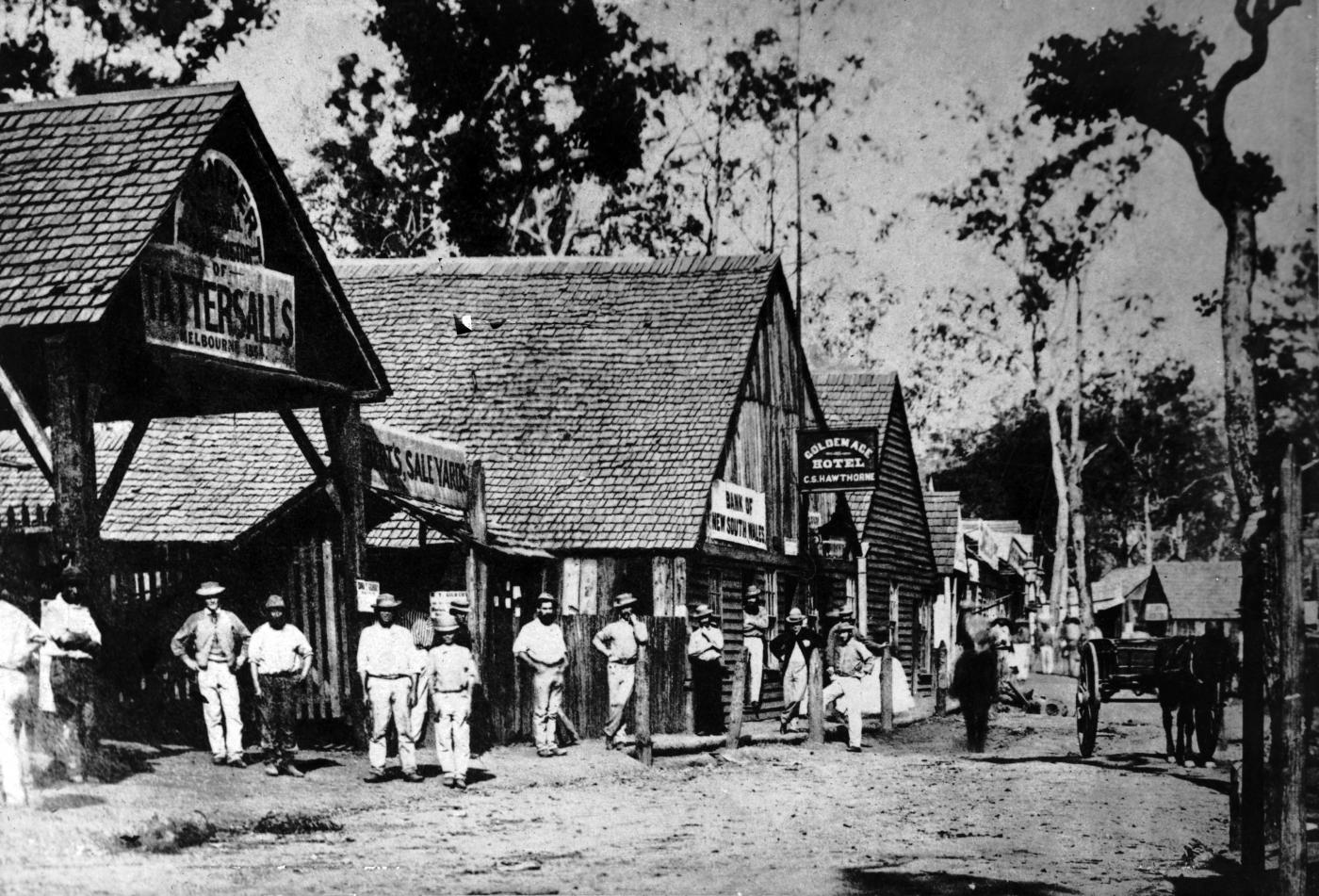
A pan, a pick and a broke colony
In 1867 Queensland was going under. Drought had hit the pastoral runs, the Bank of Queensland had closed, work on the railway from Ipswich to Toowoomba had stopped, and unemployed men were marching in Brisbane. The government had offered a £3,000 reward for a new payable goldfield.
That August a 32-year-old prospector from Wiltshire named James Nash was walking from Nanango to Gladstone with a panning dish, a pick and his dog. What he found near the Mary River set off Queensland’s first great gold rush.
You can still pan the creek on the edge of town. Deep Creek, at Gympie’s southern entrance, is a public fossicking area, and all you need is a pan and a Queensland fossicking licence. Details are further down.
What happened
Gold before Nash. Nash wasn’t the first to see gold here. John Carne Bidwill, the first Land Commissioner of Wide Bay, found some near Gympie in 1851, but nothing came of it.
The find, 1867. Nash had worked the New South Wales goldfields before moving to Queensland in 1863. On his way north he found a few colours (tiny flecks of gold) at Yabba Creek near Imbil and at Six Mile Creek. Then he struck rich ground at what became Caledonian Hill and Nash’s Gully. In a day and a half he took about 33 g of gold. He broke his pick, walked to Maryborough for a new one, came back and took 2.1 kg (75 ounces) in six days.
The claim, 16 October 1867. Writing from Maryborough, Nash told the government: “I hereby claim the reward offered for the discovery of gold fields”. The field, he said, was about 50 miles from Maryborough. His letter survives in the Queensland State Archives. The Australian Dictionary of Biography calls what followed “one of the wildest rushes in Queensland history”.
Nashville becomes Gympie, 1868. The rush town was first called Nashville. In 1868 it took the name Gympie, from the Gubbi Gubbi word gimpi gimpi, the stinging tree.
The reward. Nash never got the full £3,000. The government ruled its terms “had not quite been met” and, after twelve months of debate, paid him £1,000.
From creeks to deep reefs. The easy alluvial gold, the loose gold in the creek gravels, went fast. Miners in partnerships sank shallow shafts on the reefs, but hard rock slowed them through the 1870s. Better machinery in the early 1880s opened up the deep quartz reefs. Gympie opened a stock exchange in 1884, and by 1901 the field had produced about 2.49 million ounces and the town had 11,959 people.
The 1893 flood. In February 1893 the Mary River rose to about 25.5 m, still the highest on record. At its lowest point Mary Street was 30 feet under water, and the pressure cracked the gas mains and damaged the mines.
The end, 1912. Gympie was declared a city in 1905, but mine returns were already sagging, and mining had all but ended by 1912. By 1921 the population had fallen to 6,537.
What it meant
The Australian Dictionary of Biography calls the Gympie field “the salvation of the depressed colony”. It produced gold worth £14,538,328. One mine alone, the No. 2 South Great Eastern, produced 10,774 kg over about 33 years, with its best years from 1899 to 1906.
It also produced a Prime Minister. Andrew Fisher was elected member for Gympie in the Queensland parliament in 1893, and went on to become Australia’s fifth Prime Minister.
Nash did less well. He and his brother made another £7,000 from their claims, then lost it on mining shares and a drapery store that failed. In 1888 the government made him keeper of the Gympie powder magazine, at £100 a year. He died in Gympie on 5 October 1913, aged 79, and the government granted his widow Catherine a pension of £50 a year. A memorial fountain, cut from a seven-ton block of granite, stands in his honour in Gympie’s park.
Panning Deep Creek today
Deep Creek fossicking area runs along the creek at the southern entrance to Gympie, between the Bruce Highway and Brisbane Road. Its gold washed down from the old Columbia, Smithfield, Monkland, Never Mind and Russell reefs.
| Licence | Queensland fossicking licence. Prices and online sales are on the licence page |
| Way in | Turnstiles at the ends of Counter Street (south, off Albert Road) and Victoria Road (north, off Graham Street). Yellow metal posts mark the boundary |
| What you can use | A pan, in the creek bed only. No digging in the banks, and no other hand tools, sluices, dredges or dry blowers |
| Camping and fires | Neither is allowed. Stay in Gympie |
| Kids and dogs | Children must be supervised by an adult. Dogs on a lead |
Where to try: the creek bed, especially on the inside of the bends.
Honest odds: the government says the creek was worked hard in the first couple of years of the rush. Fine colours in the bottom of the pan are the realistic hope, not nuggets. New to panning? Read our guide to panning for gold first.
Watch out for: the creek floods with the seasons. Take your rubbish home, and leave the platypus and turtles in peace.
Around Gympie: make a weekend of it
The gold built Gympie, and the timber and the railway kept it going. These are the places that tell the rest of the story. Hours and prices change, so check each venue’s own site before you go.
| Place | What it is | Where |
|---|---|---|
| Gympie Gold Mining and Historical Museum | More than 30 historic buildings and machinery on the site of the No. 2 South Great Eastern mine. The collection runs from Nash’s 1867 find to the Eldorado mine, which closed recently | 215 Brisbane Road, Gympie |
| Mary Valley Rattler | A volunteer-run heritage steam train from Gympie to Amamoor, through Dagun, with a restored turntable at Amamoor. The Mary Valley line opened to Brooloo in April 1915, and the Rattler first ran in May 1998 | Historic Gympie Station, Tozer Street |
| Historic Gympie Station | Built in 1913 in the timber “pagoda” style, and possibly the largest timber railway building Queensland put up in the 20th century. Now a cafe, shop and museum | Tozer Street, Gympie |
| Woodworks Forestry and Timber Museum | Logging and sawmilling history, with a working steam sawmill, pioneer forestry tools and a restored 1925 Republic winch truck. Opened in 1984 near the site of the district’s first sawmill, from the 1860s | 8 Fraser Road, Araluen |
| Gympie Region Heritage Trails | 34 signposted places across Gympie, the Mary Valley, Kilkivan, Goomeri and the Cooloola Coast, including Andrew Fisher’s cottage and the Dickabram Bridge | Across the region |
| Gympie Town Hall | Opened in 1890 on land set aside for it in 1883, and one of the stops on the heritage trail | Central Gympie |
| Kilkivan Museum | More than 22,000 local items and about 5,000 mineral specimens. Opening times are on its Facebook page | 12 Bligh Street, Kilkivan |
You can pick up a fossicking licence at the Lake Alford Visitor Information Centre, at the southern entrance to Gympie, before you head to Deep Creek.
Markets. Plan your visit around one of these:
- Museum Markets, in the gold museum gardens at 215 Brisbane Road, on the first, third and fifth Sundays of the month.
- Kin Kin Market, on Main Street, Kin Kin, on the first Sunday of the month.